
 The Rendezvous also afforded the opportunity to present work from the WELL project and NC-FEW.
Forbes, C.T., Scherer, H., Li, C., Millenbah, K., Sintov, N., & Wang, H-H. (2018, July). Building a National Collaborative for Food, Energy, and Water Education (NC-FEW): Insights from a national conference. Poster presented at the Earth Educators Rendezvous (EER), Lawrence, KS.
Lally, D., Forbes, C.T., McNeal, K., & Soltis, N. (2018, July). National Survey of Geoscience Teaching Practices 2016: Current trends in geoscience instruction of scientific modeling and systems thinking. Presentation at the Earth Educators Rendezvous (EER), Lawrence, KS.
Petitt, D., Lally, D., Forbes, C.T., Brozovic, N., & Franz, T. (2018, July). Water in society: undergraduate learning and reasoning about socio-hydrological issues. Paper presented at the Earth Educators Rendezvous (EER), Lawrence, KS.
It was wonderful to engage with the geoscience education community and spend time on the KU campus. As always, Rock Chalk, Jayhawk!
]]>


 ]]>


]]>
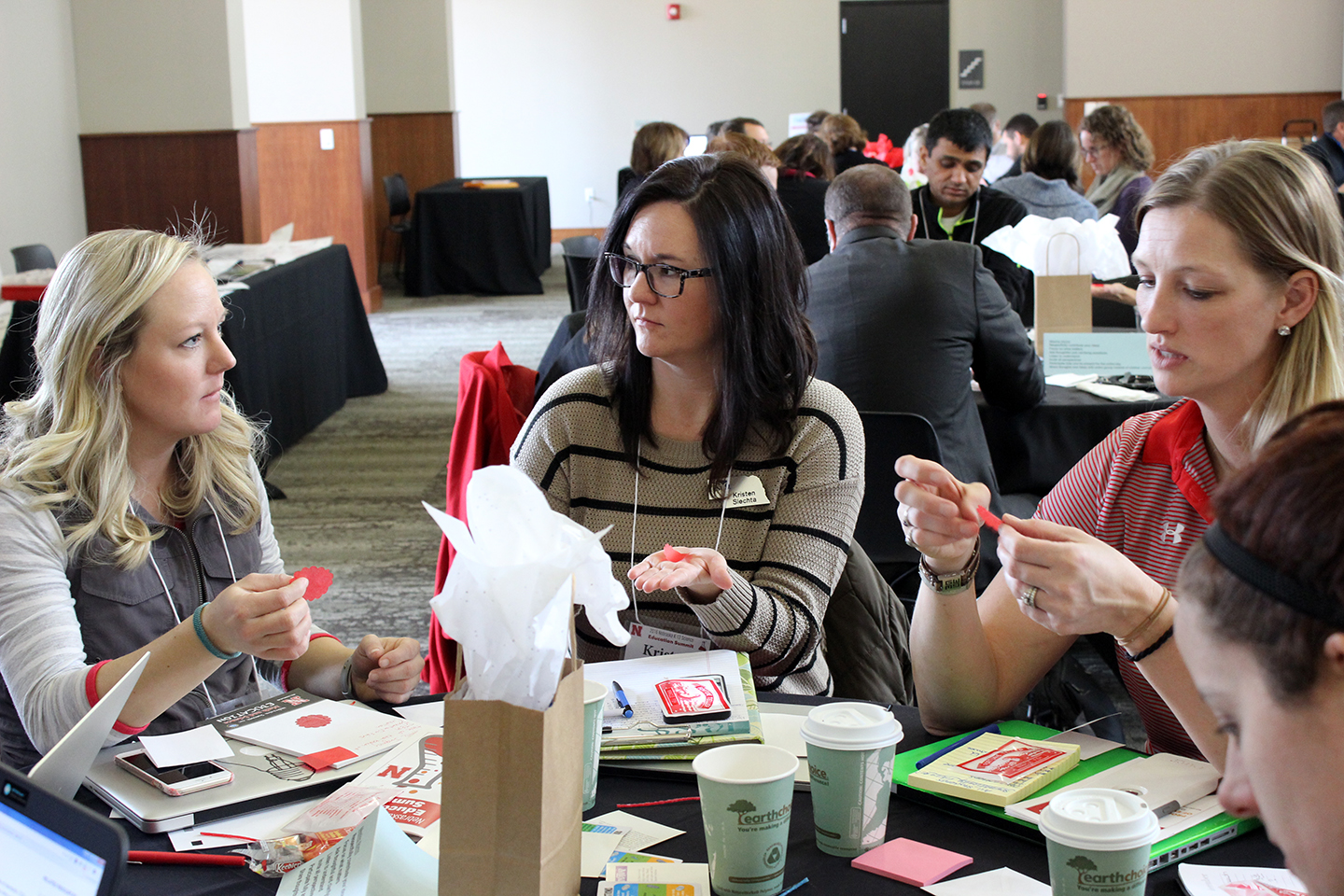
 On Monday, December 12th, over 175 science educators from across the state of Nebraska had the opportunity to come together at Nebraska Innovation Campus in Lincoln for the Nebraska K-12 Science Education Summit. Organized and led by Sara Cooper, Science Education Director at the Nebraska Department of Education, and I, the event provided a forum for science education administrators, science teachers, STEM faculty, and stakeholders to engage in statewide discussions about K-12 science education efforts. This included a workshop on the Next Generation Science Standards and Nebraska state science standards, as well as concurrent sessions in which UNL faculty and others shared innovative science education resources and strategies with practitioners. We were fortunate to have Chancellor Ronnie Green stop by in the afternoon to welcome attendees and provide some critical insights into the importance of collaboration between K-12 schools and the NU system. The event was co-sponsored the Nebraska Department of Education, IANR Science Literacy, NebraskaSCIENCE, the Center for Science, Mathematics, and Computer Education, Nebraska 4-H, and the Nebraska Collaborative for Food, Energy, & Water Education. This was a wonderfully productive experience for all involved and we look forward to holding the event again in future years to enhance and synergize the teaching and learning of science in Nebraska.


 ]]>
Dauer, J. & Forbes, C. T. (2016). Making decisions about complex socioscientific issues: A multidisciplinary science course. Science Education & Civic Engagement: An International Journal, 8(2), 5-12.
]]> At the end of June, I had the wonderful opportunity to participate in the Academic Leadership Academy (ALA) at Penn State University. The ALA provides a multi-day professional development program for higher education administrators through Penn State’s Center for the Study of Higher Education and Higher Education Program. The experience was a wonderful way to learn new skills and engage with other academic leaders from all types of institutions from across the U.S. Thanks to CASNR and Extension for co-investing in my ongoing professional growth!
]]>