 Early this month I had the opportunity to travel to Enschede in the Netherlands to give an invited talk at the International Conference on New Teacher Competencies. The conference was held at the University of Twente and was sponsored by DoCenter, Center for Knowledge Creation on Teacher Development and Curriculum Design, and SLO (National Institute for Curriculum Development in The Netherlands). Through my talk, entitled ‘Supporting teachers use of curriculum materials for science: Empirically-grounded perspectives on teachers’ curriculum design competencies’, I was able to share conceptual foundations and research findings from our work with elementary teachers to use instructional materials for science in the PIESC3, RAES, and MoHSES projects. It was a great opportunity to learn from others similarly interested in instructional design, teacher design teams, and supporting teachers to use curriculum materials effectively. Thank you to Jules Pieters, Joke Voogt, Adam Handelzalts, Nienke Nieveen, Maaike Heitink, and Sandra Schele for being wonderful hosts and making the trip both productive and enjoyable.
]]>
 This month, I was invited to the Lawrence Hall of Science where I gave an invited talk to the FOSS team. While attending AERA in San Francisco, graduate students Mandy Biggers, Laura Zangori, and I made the trip to Berkeley to share research and programming from RAES-Iowa project and learn more about the work being conducted by the FOSS group. Thanks to Kathy Long for inviting us and making it such an enjoyable visit.
]]>
Forbes, C.T. (2013). Curriculum-dependent and curriculum-independent factors in preservice elementary teachers’ adaptation of science curriculum materials for inquiry-based science. Journal of Science Teacher Education (24)1, 179-197.
The results presented in the article are part of a larger study of preservice elementary teachers’ learning to use science curriculum materials to teach science as inquiry. This work informs our present work on the PIESC3, RAES, and MoHSES projects.
]]>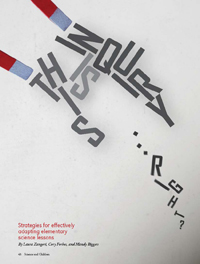 A paper from the PIESC3 group has just been published in the September issue of Science and Children. The article outlines and describes accessible strategies for modifying existing science lessons and curriculum materials to better engage students in ‘science as inquiry‘ and scientific practices.
Zangori, L., Forbes, C., & Biggers, M. (2012). This is inquiry…right? Strategies for effectively adapting elementary science lessons. Science and Children, 50(1), 48-53.
These strategies have been developed, used, and refined through almost 10 years of work with both preservice and inservice elementary teachers as part of the CASES and PIESC3 project research. We are excited to share them with many more teachers through Science and Children!
]]>Biggers, M., Forbes, C.T., & Zangori, L. (2012, April). Elementary teachers’ curriculum design and pedagogical reasoning for supporting students’ comparison and evaluation of evidence-based explanations. Paper presented at the annual meeting of the American Educational Research Association, Vancouver, BC.
Forbes, C.T., Biggers, M., & Zangori, L. (2012, April). Investigating essential characteristics of scientific practices in elementary science learning environments: The Practices of Science Observation Protocol (P-SOP). Paper presented at the annual meeting of the American Educational Research Association, Vancouver, BC, April 13-17.
Forbes, C.T., Biggers, M., & Zangori, L. (2012, April). Toward an empirically-based learning progression: Defining progress variables and measurable levels of elementary teachers’ pedagogical content knowledge for science. Paper presented at the annual meeting of the American Educational Research Association, Vancouver, BC.
Aguirre-Mendez, C., Promyod, N., Forbes, C.T., Biggers, M., & Zangori, L. (2012, March). Characteristics of scientifically-oriented questions and the nature of inquiry in elementary classrooms: A multiple-case study. Paper presented at the annual meeting of the National Association of Research in Science Teaching, Indianapolis, IN.
Biggers, M. & Forbes, C.T. (2012, March). Elementary teachers’ ideas about, planning for, and implementation of learner-guided and teacher-guided inquiry. Paper presented at the annual meeting of the National Association of Research in Science Teaching, Indianapolis, IN.
Biggers, M., Zangori, L., & Forbes, C.T., (2012, March). Exploring scientific explanations: Promoting students’ sense-making in elementary classrooms. Paper presented at the annual meeting of the National Association of Research in Science Teaching, Indianapolis, IN.
Forbes, C.T., Biggers, M., & Zangori, L. (2012, March). Elementary teachers’ enactment of science curriculum materials: Investigating early learners’ engagement in scientific practices. Paper presented at the annual meeting of the National Association of Research in Science Teaching, Indianapolis, IN.
Pinney, B., Suh, J-K., Tseng, C-M., Forbes, C.T., Biggers, M., & Zangori, L. (2012, March). Dichotomous inquiry practices: Characterizing teaching practice based on essential features of inquiry. Paper presented at the annual meeting of the National Association of Research in Science Teaching, Indianapolis, IN.
Zangori, L. & Forbes, C.T., (2012, March). Learning to support elementary students’ scientific reasoning: Preservice elementary teachers and the evidence-explanation continuum. Paper presented at the annual meeting of the National Association of Research in Science Teaching, Indianapolis, IN.
Forbes, C.T. (2012, February). Fostering sense-making in K-8 science learning environments through curriculum and instruction: An evolving research agenda. Invited presentation at the University of Münster (WWU-Münster), Münster, Germany. Sponsored by the German Research Foundation (DFG).
Forbes, C.T. (2012, January). Fostering sense-making in K-8 science learning environments through curriculum and instruction: An evolving research agenda. Invited presentation at the University of Essen (NWU-Essen), Essen, Germany. Sponsored by the German Research Foundation (DFG).
]]>Forbes, C.T. (2011). Preservice elementary teachers’ adaptation of science curriculum materials for inquiry-based elementary science. Science Education, 95(5), 927-955.
]]>Davis, E.A., Beyer, C., Forbes, C.T., & Stevens, S. (2011). Understanding pedagogical design capacity through teachers’ narratives. Teaching and Teacher Education, 27(4), 797-810.
]]>Forbes, C.T. & Davis, E.A. (2010). Curriculum design for inquiry: Preservice elementary teachers’ mobilization and adaptation of science curriculum materials. Journal of Research in Science Teaching, 47(7), 365-387.
]]>