Zangori, L. & Forbes, C.T. (2013). Preservice elementary teachers and explanation construction: Knowledge-for-practice and knowledge-in-practice. Science Education, 97(2), 310-330.
This research are part of a larger study of preservice elementary teachers’ learning to use science curriculum materials to teach science as inquiry (Biggers & Forbes, 2012; Forbes, 2013; 2011; Forbes & Davis, 2010). The findings presented in this article build upon these previous studies to illustrate how preservice elementary teachers both conceptualize and learn to support students’ explanation-construction in elementary classrooms.
]]>Forbes, C.T. (2013). Curriculum-dependent and curriculum-independent factors in preservice elementary teachers’ adaptation of science curriculum materials for inquiry-based science. Journal of Science Teacher Education (24)1, 179-197.
The results presented in the article are part of a larger study of preservice elementary teachers’ learning to use science curriculum materials to teach science as inquiry. This work informs our present work on the PIESC3, RAES, and MoHSES projects.
]]>Biggers, M. & Forbes, C.T. (2012). Balancing teacher and student roles in elementary classrooms: Preservice elementary teachers’ ideas about the inquiry continuum. International Journal of Science Education, 34(14), 2205-2229.
This research are part of a larger study of preservice elementary teachers’ learning to use science curriculum materials to teach science as inquiry (Forbes, 2011; Forbes & Davis, 2010). The findings presented in this article build upon these previous studies to illustrate how preservice elementary teachers conceptualize the continuum from more student-directed to teacher-directed inquiry and use it to make instructional decisions for science.
]]>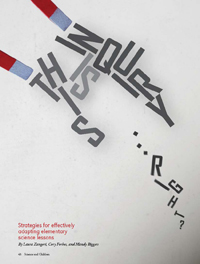 A paper from the PIESC3 group has just been published in the September issue of Science and Children. The article outlines and describes accessible strategies for modifying existing science lessons and curriculum materials to better engage students in ‘science as inquiry‘ and scientific practices.
Zangori, L., Forbes, C., & Biggers, M. (2012). This is inquiry…right? Strategies for effectively adapting elementary science lessons. Science and Children, 50(1), 48-53.
These strategies have been developed, used, and refined through almost 10 years of work with both preservice and inservice elementary teachers as part of the CASES and PIESC3 project research. We are excited to share them with many more teachers through Science and Children!
]]>Forbes, C.T. (2011). Preservice elementary teachers’ adaptation of science curriculum materials for inquiry-based elementary science. Science Education, 95(5), 927-955.
]]>Forbes, C.T. & Davis, E.A. (2010). Curriculum design for inquiry: Preservice elementary teachers’ mobilization and adaptation of science curriculum materials. Journal of Research in Science Teaching, 47(7), 365-387.
]]>