Our team is excited to announce grant support for the Water Education Leaders for Secondary Science (WELS2) project at the University of Nebraska-Lincoln (UNL). Through funding from USDA-NIFA and the NE Coordinating Commission for Postsecondary Education, we will develop, implement, and evaluate a 15-month sustained professional development program for middle and secondary STEM teachers in the state of Nebraska focused on teaching and learning about water resources. This project is grounded in a partnership involving the UNL School of Natural Resources, Robert B. Daugherty Water for Food Global Institute, UNL water scientists, the Groundwater Foundation, and six Nebraska school districts. More information about the project can be found here and here.

Category Archives: Teaching
Fall, 2016 teaching SCIL 101 Science and Decision-Making for a Complex World
In the Fall, 2016 semester, I had the wonderful opportunity to teach one of four large sections a required course for all CASNR students – SCIL 101 Science and Decision-Making for a Complex World. The class, re-conceptualized and redeveloped from a long-standing introductory course (AGRI/NRES 103 Introduction to Agricultural and Natural Resource Systems), involves students learning to make science-informed decisions about agriculture and natural resource issues. Comprised of four modules designed around food, energy, and water issues, SCIL 101 offers students the opportunity explore these challenges issues from multiple perspectives, ultimately conducting independent research on a question of their choosing. My section of the class this fall had 130 students, almost half of which were CASNR undergraduate students from Rwanda studying in IANR to become future agricultural leaders in their home country. I am also very lucky to have had the opportunity to work with an amazing team of graduate and undergraduate teaching assistants, including WELL project graduate students Diane Lally and Destini Petitt, and Science Literacy graduate student McKenzie Peterson.
Collaboration w/ ReSTEM Institute at University of Missouri
Thanks to Troy Sadler, Laura Zangori, and the rest of the team with the ReSTEM Institute in the University of Missouri College of Education for a engaging and productive couple of days of collaboration with Jenny Dauer and myself. It was a great conversation around socio-scientific issues, science-informed decision-making, and science literacy in a range of K-16 contexts and across an array of unique projects. I look forward to working with ReSTEM as the external evaluation team on the Fostering Undergraduate Students’ Disciplinary Learning and Water Literacy (WELL) project, funded by an NSF IUSE grant (DUE-1609598), and the SCIL/AECN/NRES 109: Water in Society course over the next 3 years.

New article published in Science Education and Civic Engagement: An International Journal
A new article co-authored by Jenny Dauer and I has been published in the Summer, 2016 issue of Science Education and Civic Engagement: An International Journal. The paper, entitled Making Decisions about Complex Socioscientific Issues: A Multidisciplinary Science Course, reports on the initial iteration of a revised version of SCIL 101, a large-enrollment, interdisciplinary, introductory undergraduate course required of all students in the College of Agricultural Sciences and Natural Resources (CASNR). The course represents a core element of programmatic efforts associated with the IANR Science Literacy Initiative to cultivate science literacy among undergraduate students at UNL.
Dauer, J. & Forbes, C. T. (2016). Making decisions about complex socioscientific issues: A multidisciplinary science course. Science Education & Civic Engagement: An International Journal, 8(2), 5-12.
WELL project press
Some nice press from the UNL news on our newly-funded, 3-year NSF IUSE project – Fostering Undergraduate Students’ Disciplinary Learning and Water Literacy (WELL; DUE-1609598) – which focuses on design-based research around the new SCIL/AECN/NRES 109: Water in Society course at UNL.
The funding will support the development of a new “Water in Society” undergraduate course. Water in Society will be an interdisciplinary course, drawing from the fields of science, technology, engineering, and mathematics (STEM) education, hydrological sciences and social and decision sciences.
[…}
“Our hope is that all UNL students, whether they’re studying to be a scientist, teacher or lawyer will have the background to make educated decisions when it comes to their food, and the Water in Society course can support that goal,” said Forbes.
NSF IUSE project funded
I am very excited to lead a newly-funded, 3-year NSF IUSE Engaged Student Learning: Exploration project (DUE-1609598) focused on the iterative design,
implementation, and study of a new, interdisciplinary course for non-majors – SCIL/AECN/NRES 109: Water in Society – at the University of Nebraska-Lincoln (UNL). The Fostering Undergraduate Students’ Disciplinary Learning and Water Literacy (WELL) project presents an outstanding opportunity to iteratively develop and study an innovative undergraduate STEM learning experience through design- and discipline-based education research. We are lucky to have an amazing, interdisciplinary team on board for this project, including faculty associated with UNL’s Water for Food Global Institute and two graduate students. The new course will be an integral part of a newly-established undergraduate minor – Food, Energy, & Water in Society – in CASNR, as well as a key component of a growing suite of undergraduate experiences associated with the IANR Science Literacy Initiative.
Wrapping up the Nebraska WETS Project
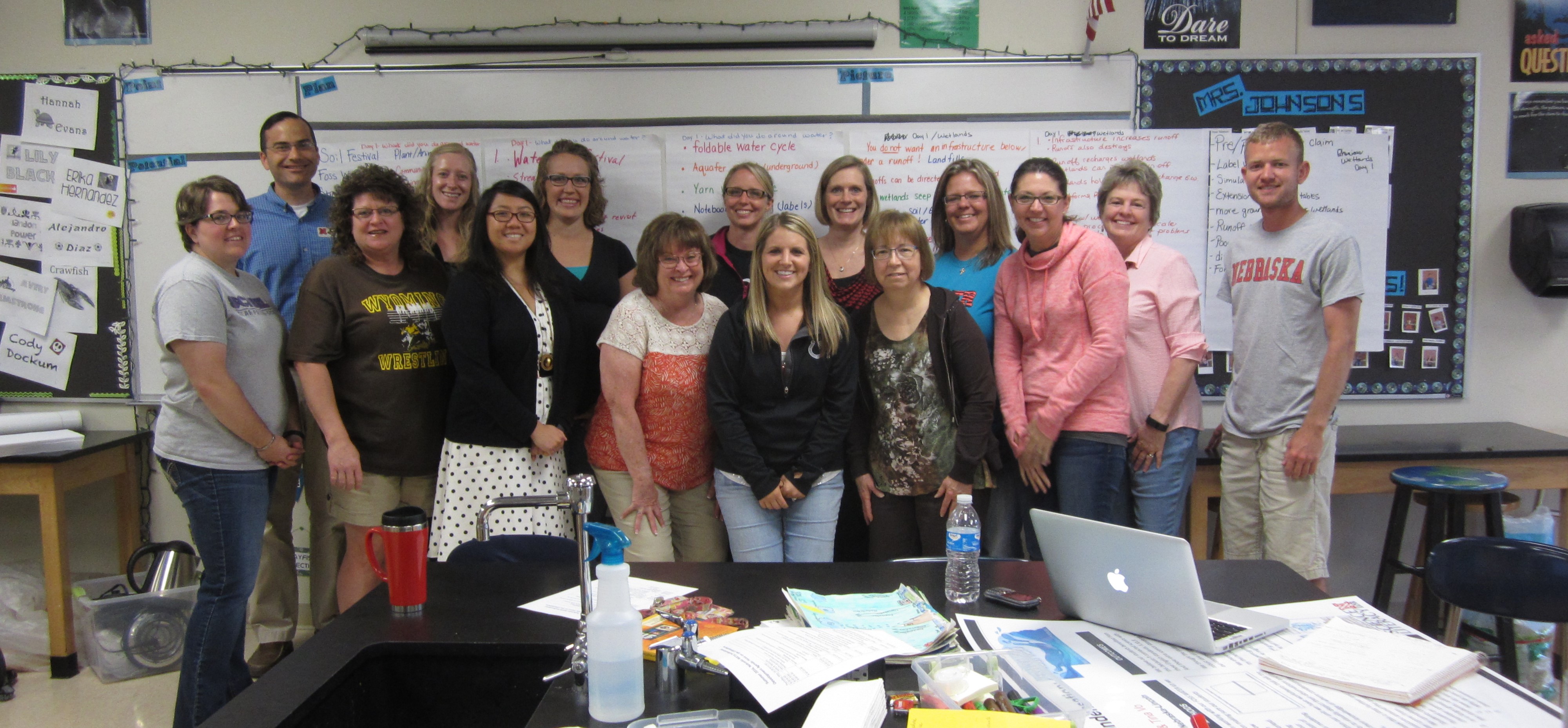
Today we wrapped up our 18-month Water for Elementary Teachers of Science in Nebraska (NE WETS) project with 2 consecutive days of workshops held at Hastings Middle School. The project provided us to opportunity to work with an amazing group of K-6 teachers from in and around Hastings, NE. Thanks go out to wonderful UNL project team members Tina Vo and Tonya Bernadt, Chad Dumas, Ph.D., HPS Director of Curriculum, Instruction, and Assessment, and the teachers who made the project possible. 
Graduation 2016 Jaime Sabel and Molly Brandt
Congrats again to Jaime Sabel and Molly Brandt for successfully completing their doctoral and masters studies. Jaime graduates with her Ph.D. from the Department of Teaching, Learning, and Teacher Education in the UNL College of Education and Human Sciences. She begins her position as an Assistant Professor of Biology Education at the University of Memphis in August. Molly graduates with a Master of Applied Science degree from the College of Agricultural Sciences and Natural Resources. What a wonderful accomplishment. Good luck to both of you!
Molly Brandt, M.A.S.
Congratulations to Molly Brandt for successfully defending her thesis study, entitled, “Exploring Elementary Students’ Agricultural and Scientific Knowledge using Evidence-Centered Design”. For the past two years, Molly has worked as a graduate assistant with the Science Literacy Initiative on STEM education projects supported with funding from USDA-NIFA and National Agriculture in the Classroom program. Her work involved developing and pilot testing assessment instruments to measure STEM-based agricultural literacy outcomes using interviews and assessment data from over 400 elementary students in school districts in Nebraska. It has been a pleasure to work with Molly as both project PI and her advisor. Molly’s thesis study was conducted in partial fulfillment of requirements for the degree of Master of Applied Science in the College of Agricultural Sciences and Natural Resources. Her committee members included Drs. Krista Adams from Teaching, Learning, and Teacher Education and Jennifer Keshwani from Biological Systems Engineering.
2015 Nebraska WETS Workshop Series
Thanks to a fantastic group of elementary teachers for all their hard work in this first summer of the Water for Elementary Teachers of Science (Nebraska WETS) project. We had a great workshop series in June and August of this summer focused on scientific modeling, formative assessment, and water science. The summer component was also offered as graduate course credit (NRES 898 – Teaching and Learning about Water Systems). We appreciate the support of Hastings Public Schools for being a wonderful district partner and allowing us access to amazing facilities at Hastings Middle School.