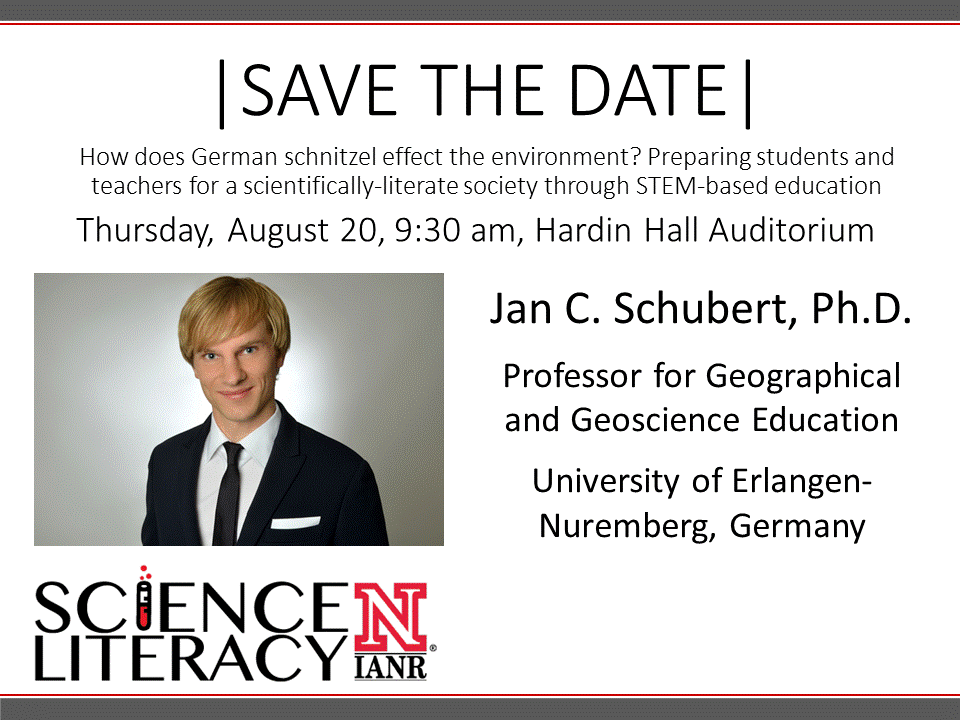
During the month of August, IANR and UNL hosted Jan C. Schubert, Ph.D. as a visiting scholar from Germany. Dr. Schubert is Professor for Geographical and Geoscience Education at the University of Erlangen-Nuremberg, Germany. During his stay, he gave an invited presentation as part of the 2015 Science Literacy seminar serites, entitled, How does German schnitzel effect the environment? Preparing students and teachers for a scientifically-literate society through STEM-based education, in which he shared information and research focused on an environmental science course for preservice secondary science teachers in Germany. Dr. Schubert’s work provides a model for innovative STEM teacher education efforts at the undergraduate level that integrate experiences with science, scientific research, and pedagogy. During his stay, he was also able to participate in teacher professional development workshops associated with the TASRs program, observe AGRI 103, and work collaboratively on a new project focused on research and development on 6th-grade students’ STEM-informed decision-making about wind energy. We look forward to ongoing collaboration with Dr. Schubert and future opportunities to work together and learn from one another. 
Tag Archives: science literacy
Dr. Mike Barnett visits UNL
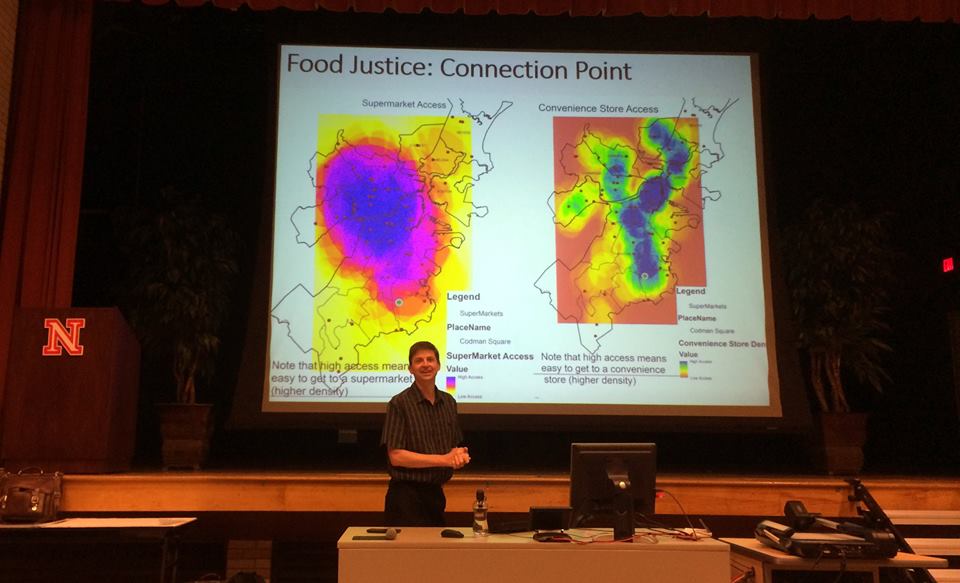
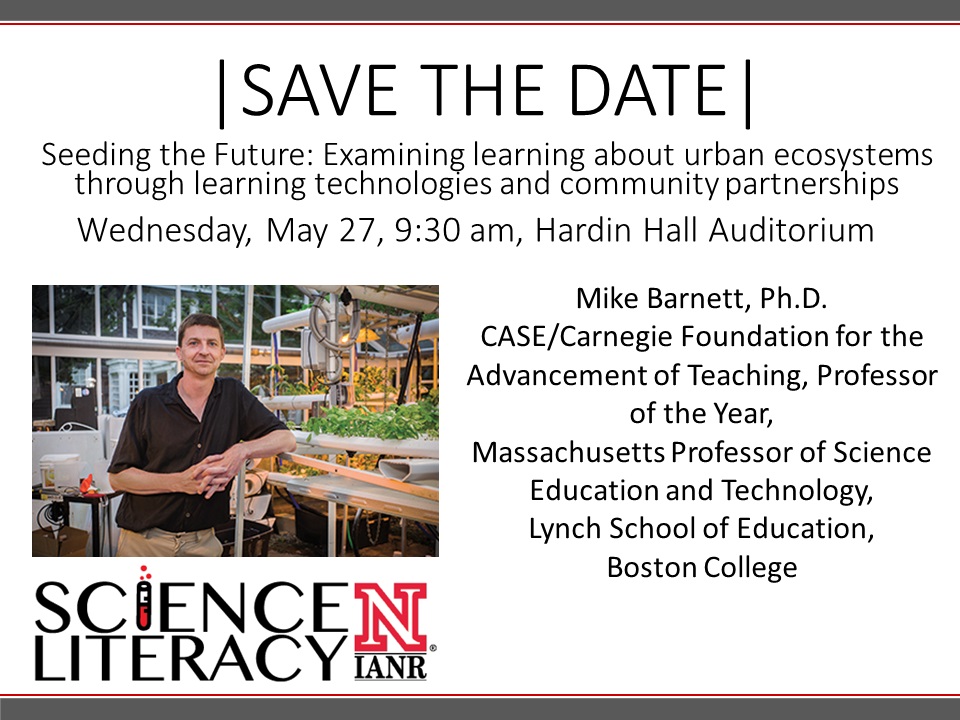
It has been a pleasure to host Mike Barnett as a visiting scholar at UNL over the past few days. Dr. Barnett is Professor of Science Education and Technology in the Lynch School of Education at Boston College. As the inaugural participant in the 2015 Science Literacy Initiative Seminar Series, he had an opportunity to give an invited presentation, entitled Seeding the Future: Examining learning about urban ecosystems through learning technologies and community partnerships. Dr. Barnett also engaged with faculty and students from both East and City campuses, contributed to faculty working groups convened in support of the Science Literacy Initiative, and even got to visit Nine-Mile Prairie with Dave Wedin, Doug Golick, and myself. It was wonderful to learn of the great work Dr. Barnett and his team are doing at BC. We all appreciate his willingness to travel to Lincoln immediately after returning from a week-long trip to China. 
STEM is great! Except when it’s not…
Kamyar Enshyan, Director of the Center for Energy and Environmental Education at the University of Northern Iowa, has an interesting op-ed piece in yesterday’s Des Moines Register. Talking about the widespread emphasis on STEM and STEM education, Enshyan observes a certain selectiveness with which knowledge and insights gained from STEM research are applied. He concludes:
It is hard to take STEM talks seriously if so much of what we already know from science is ignored routinely on matters vital to our health, the land and our economy.
Enshyan’s critique is directed primarily at policymakers and industry leaders, but the implications are much broader. Having good information and access to it may not be sufficient. It is also critical that we account for how STEM knowledge is used in the various economic, political, and social spheres of life in pursuit of particular goals and outcomes. This, of course, requires systemic, usable science literacy among individuals in all of these groups.
Is The Food That’s Good For You Good For The Environment?
Here’s a very accessible and nicely-done article that weighs the pros and cons of various approaches to agricultural production. The author emphasizes the importance of tradeoffs in assessing the impact of growing certain commodities using conventional or organic methods, including not only the use of synthetic fertilizers, but also water use, transportation, and consumer demand. Some interesting information about avocados.
NCAL in the news
An article in this week’s Lincoln Journal Star highlights the work we’re doing as part of the National Center for Agricultural Literacy. This initial phase of the center’s life will lay the foundation for longer-term work to support nationwide K-12 science and ag literacy efforts in partnership with the Agriculture in the Classroom program. We’re looking forward to our upcoming summer program linking high school science teachers with IANR researchers to produce science instructional materials grounded in ag and natural resource topics and issues.
Peak Ag?
A new study conducted by an international team of scientists suggests increases in agricultural production have likely peaked. The research, published in Ecology and Society, also indicates peaks for individual resources such as corn, soybeans, cotton, milk, etc., are interrelated, or synchronized, around the year 2006. This is perhaps not surprising given the interdependent patterns of natural resource use and agricultural production. As the world’s population continues to grow, empirical findings such as these have crucial implications for global food security and natural resource management.
New Pew research examines public and scientists’ views on science and society
The Pew Research Center has released findings of a survey of 2,002 American adults and 3,748 U.S.-based members of the American Association for the Advancement of Science. There is a lot of great information in here that illustrates how scientists and the public view science, it’s role the world, STEM education, and each other. What they collectively illustrate is the ongoing need to foster science literacy in the United States. As Pew’s Lee Rainie argues:
“Science issues are increasingly civic issues, and they’re not distinct. They’re not off to the side,” he said. “They’re at the center of what defines the culture and the society and how people live their lives.”
In short, science in highly relevant to and impacts our day-to-day lives. It’s crucial that everyone learns to use science to interpret, analyze, and make effective decisions about challenging, real-world issues.
Science Literacy ‘Big Ideas’ Seminar at UNL
UNL’s 2014 ‘Big Ideas’ Seminar series kicks off on February 19 with a 1-day event showcasing science literacy. Breakout sessions beginning at 1:00 will highlight systems thinking around food, energy, and water systems, informal science education, early childhood education, the role of rural family-school partnerships. Dr. Rodger Bybee will give a presentation at 3:00 entitled “Building Science Literacy through Engagement in Community and Environmental Stewardship”. Seminar co-sponsors include IANR; UNL Extension; Department of Child, Youth and Family Studies; College of Education and Human Sciences; and Nebraska Center for Research on Children, Youth, Families and Schools. It will be a fantastic opportunity to engage with state partners and learn more about science literacy.
UNL IANR science literacy press
Here is a sampling of media coverage of the large cluster hire undertaken by UNL’s Institute for Agriculture and Natural Resources, including the personnel associated with the Science Literacy Initiative.
From NebraskaSCIENCE – New science education hires at UNL
From IANR News – New Science Literacy Initiative Faculty On Board at UNL
From the Robert B. Daugherty Water for Food Institute – UNL’s Institute of Agriculture and Natural Resources announces new positions
From the Omaha World Herald – UNL to add 36 ag-related professors by 2014
From IANR (video via YouTube) – IANR New Faculty Positions
Moving to UNL!
It’s official, this fall I’ll be transitioning to a new position at the University of Nebraska-Lincoln (UNL) as Associate Professor of Science Education in the School of Natural Resources (SNR) and Science Literacy Coordinator for the Institute for Agriculture and Natural Resources (IANR). I’m super excited to join an amazing group of STEM scholars and begin the next stage of my professional career. Thanks to family, friends, and colleagues who have been so supportive in this process. We’re moving to Lincoln!